

Mole Removal

LONDON

DE FELIPE group is an international network of clinics and not all treatments are available at every location. We kindly invite you to contact us to confirm whether the treatment you require is offered at your chosen clinic.

Types of moles

Remove your moles and skin tags is easier than what you think.
There are many types of moles on your skin. It is important that we identify and classify the type of lesion that you have in order to decide whether you need a treatment or not.
Benign moles or Moles can be classified as:

Melanocytic nevi

Melanocytic nevi can be classified as well in three types according to their position in the skin: they can be Junctional nevi if they are located in between the epidermis and the dermis, Intradermal nevi if the are deeper, and mixed if the occupy the whole thickness of the skin.

Epidermal nevi

Epidermal nevi are abnormal, non cancerous (benign) skin lesions caused by excessive growth of cells in the epidermis. Epidermal moles are usually visible from the moment the patient is born or at an earlier age. People with epidermal nevi usually have more than one in different areas of the body.

Sebaceous nevi

It is a mole made of sebaceous glands so it doesn’t have the typical brownish color. It occurs very often on the scalp, is yellowish to orange color and the surface is shiny or a little bit risen. It is benign and there is no need to remove it or biopsy it.

There are also rarer moles like Spitz Nevus, Becker Nevus, Congenital Nevus and Spilus Nevus. These can be diagnosed easily by the Dermatologist with a special lens called Dermatoscopy.

Before the procedure

GET IT SCANNED WITH DEMOSCOPY OR EPILUMINISCENCE BY A DERMATOLOGIST
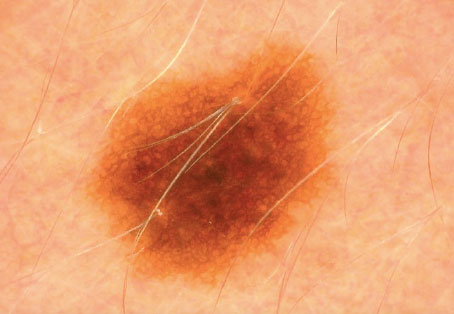
Simple eye examination is not enough. Dermatologists use a special device to see more and better.

Naked eye

This is how a mole looks to the naked eye.

By dermoscopy

This is what a dermatologist can see with dermoscopy.

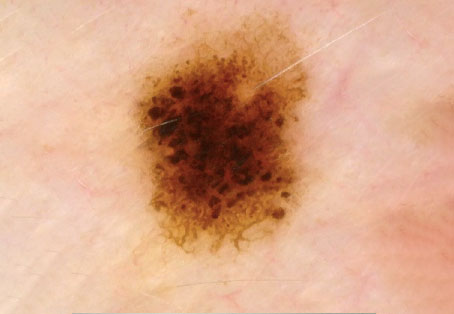
By dermoscopy

And this is how a malignant melanoma looks by dermoscopy.

It looks confusing

And this mole might look malignant but it is not. Don’t worry if it looks confusing. Have a dermatologist examine this for you properly.

Inicial diagnosi

Moles can be completely benign (MELANOCYTIC NEVI), can be bad tumors (MALIGNANT MELANOMA), or can be in between, moles that start changing and may become malignant one day (DYSPLASTIC NEVI).

You will be given an initial diagnosis, either:

IF THEY LOOK ALRIGHT

Your mole looks fine and you can keep it or remove it by the shaving procedure.

Everyone of us has several Melanocytic Nevi, usually in a reduced number of less than 50. They are regular, oval or round, symmetric, have one or two colors usually and their borders are neat and clear. Having too many Melanocytic Nevi may mean that you are prone to develop bad moles in the future. Therefore you are recommended to get your moles scanned.

IF THE LOOK ALLRIGHT, DECIDE WHICH ONES YOU WANT TO REMOVE

YOUR MOLE DOESN’T LOOK RIGHT

Your mole doesn’t look right and you should have it excised and sent it to the pathologist to confirm the diagnosis.

Malignant Melanoma is a bad tumor and may look irregular, have several different colors and bleed sometimes. If not removed on time it may produce metastases and kill you. Its incidence is increasing specially among white skin population.

IF THEY DON’T LOOK BENIGN: GET THEM BIOPSIED

We offer you the possibility of having your mole removed and sent to the pathologist to determine whether it was really a malignant or dyslplasic nevus or not.

Moles treatment in London

The mole removal procedure takes around 5 minutes and is comfortable for the patient.
This is how we do it:

  • 1. Injection of local anesthesia.
  • 2. We use a cold blade to flatten the mole and remove it.
  • 3. We reduce the bleeding coagulating with radiofrequency or Monsel Solution.
  • 4. The post procedure is very simple, it is important to apply a regenerating cream and avoid the sun for the first few days. During the following weeks the skin will heal and the wound will be imperceptible.

DE FELIPE group is an international network of clinics and not all treatments are available at every location. We kindly invite you to contact us to confirm whether the treatment you require is offered at your chosen clinic.

Mole removal treatment price London

The price of the different procedures for the treatment of mole removal is:

Single session fee

Price according to session

Mole removal

Method of removal: Superficial shave under local anesthesia and laser cauterised. Includes dermatoscopy exam and report.

MOLES

  • 1

SCALPEL + RF

£350

C02

£450

  • 2

£400

£500

  • 3

£450

£550

  • 4

£500

£600

  • 5

£550

£650

  • 6

£575

£700

  • 7

£600

£750

  • 8

£625

£800

  • 9

£650

£850

  • 10

£700

£900

  • 15

£800

£1100

  • 20

£900

£1300

  • 25

£1000

£1400

  • 30

£1100

£1500

Skin tag

Radiofrequency or electrofrequency removal. Required topical anesthesia but not injected.

  • Skin tag removal 1-3

£300

  • Skin tag removal 4-20

£450

  • Skin tag removal 21-40

£500

  • Surgical excision of cyst/Lipoma with suture (one)

£500

  • Surgical excision of cyst/Lipoma with suture (2-4)

£750

  • Xanthelasma removal (up to four)

£550

  • Upper Blepharoplasty

£1500

  • Lower Blepharoplasty

£1500

  • Upper and Lower Blepharoplasty

£2500

  • Pathology lab report only (add to surgery)

£150

  • Complex Surgical excision (flap)

£1000

  • Photodynamic Therapy (Actinic Keratosis or pre-cancer) 4 sessions program

£1000

Frequently asked questions about mole removal

The most frequently asked questions about mole removal can be found here:

No, before starting the procedure, cream and/or injected anesthesia is applied so that the patient does not feel pain.
It can be done at any time of the year as long as the treated area is not exposed to the sun.
Yes, topical or injected anesthesia can be applied.
Normally it is not usually necessary, only in some cases it is necessary to put stitches.
It depends on the size of the mole, for moles of normal size the scar becomes practically imperceptible after the third month.