


Lichen Planus Pilaris


IN LONDON

DE FELIPE group is an international network of clinics and not all treatments are available at every location. We kindly invite you to contact us to confirm whether the treatment you require is offered at your chosen clinic.

What is it?

Lichen planus pilaris (LPP) is a type of scarring alopecia, where the inflammation that develops around the hair destroys it, causing it to disappear permanently.

It occurs in certain areas of the upper scalp, such as the parietal region. It occurs primarily in middle-aged women and is frequently associated with other autoimmune disorders.

Causes

Lichen planus pilaris occurs as a result of an immune reaction in which our lymphocytes turn against certain unknown antigens in the hair follicle.

Although the cause is autoimmune, certain genes are known to predispose to the development of this disease.

Clinical Signs

There are different clinical signs that allow us to diagnose Lichen Planus Pilaris (LPP) compared to other types of alopecia, and understanding them will be key to proposing an accurate treatment plan:
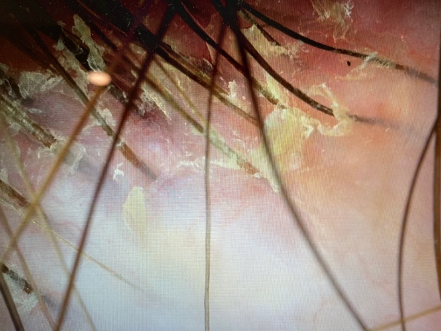
  • Redness around the hair root or perifollicular erythema.
  • Follicular hyperkeratosis.
  • Frontotemporal hairline recession.
  • Solitary hair sign.
  • Itching and pain. Trichodynia.
  • Hair loss in the eyebrow. This is a very frequently associated sign. It can also affect the armpits, pubis, forearms, or eyelashes.
  • It primarily affects postmenopausal women.
  • It is recognized by small bald areas on the scalp resembling snow footprints (footprints in grass) and by the characteristic itchy scalp.
  • When the hair is examined closely with a dermatoscope, redness around the hair root and a very characteristic cylindrical scaling are observed.
  • LPP is classified as scarring alopecia, meaning the destroyed hair cannot regrow.
  • The goal of treatment is to halt the progression of the disease, not to restore the hair, as it has been destroyed by this inflammatory process.

Diagnosis

The diagnosis is established using the following criteria:

  1. The appearance of characteristic clinical signs such as itching, redness, bald areas resembling «snow footprints» or «footprints in grass,» and the location of the lesions in the parietal region of the scalp.
  2. Characteristic trichoscopic signs include disappearance of follicular openings, perifollicular erythema, perifollicular casts, and telangiectasias.
  3. In some cases, there may be some overlap with frontal fibrosing alopecia, so a skin biopsy may be performed to rule out one or the other. These biopsies reveal the fibrosis and scar tissue typical of LPP.
  4. A series of major criteria (2018) have been proposed for the diagnosis of LPP or FFA, including: scarring alopecia in the characteristic areas and diffuse bilateral alopecia in the eyebrows, and minor criteria such as:
    a) characteristic trichoscopy with peripapillary erythema, peripillary scaling, or both
    b) histology with fibrosis
    c) involvement of other areas such as hair loss on the body, face, etc.
    The diagnosis could be established with two major criteria, or one major and one minor.
  5. There are no blood findings that help confirm the diagnosis of Lichen Planus Pilaris, but there is an association with other autoimmune diseases such as hypothyroidism, rosacea, or fibrosing frontal alopecia.
    There is no consensus regarding whether screening for all of these diseases should be performed in these patients.

DE FELIPE group is an international network of clinics and not all treatments are available at every location. We kindly invite you to contact us to confirm whether the treatment you require is offered at your chosen clinic.

Lichen Planus Pilaris treatment price London

The price of the different procedures for the treatment  is:

Single session fee

Treatments

Platelet-Rich Plasma (PRP)

£250

Microinjections with minoxidil

£100

Microinjections with 5AR inhibitors

£100

Microinjections with hair growth enhancers

£100

Microinjections with anti-inflammatories

£100

Microinjections with antiandrogens

£100

Low-Level Laser

£50

Stem Cells or Nanofat

£1500

Neuromodulators

£450

Monofilament Threads

£450

Exosomes

£450

De Felipe Male Androgenetic Alopecia (MAA) Program

£1200

Includes:

  • Diagnostic Trichology Consultation
  • 6 Platelet-Rich Plasma (PRP) Sessions
  • 6 microinjection sessions with Co-trichosteroids
  • 6 sessions of microinjections with Dutasteride
  • 6 sessions of microinjections with Finasteride
  • 6 sessions of microinjections with Minoxidil
  • 6 sessions of 635 nm photobiological therapy

Frequently asked questions

The most frequently asked questions about lichen planus pilaris can be found here:

Unfortunately, there is still no cure for lichen planus pilaris, but there are treatments that can slow its progression and control its symptoms. Early diagnosis is essential to treat it before the follicle is destroyed, which is irreversible in this case.
Although it may have an unusual name, lichen planus pilaris is not a contagious condition. It is not transmitted from person to person; rather, it is caused by an autoimmune disorder.
Lichen planus pilaris still has no cure, so we cannot establish a specific treatment time. Generally, if lichen planus pilaris is diagnosed at an early stage and its symptoms are controlled before the follicle is destroyed, treatment will end once the inflammation is under control. In addition, we can perform treatments that stimulate hair growth in follicles affected by lichen planus pilaris that have not been yet destroyed.
Lichen planus pilaris is an autoimmune condition that occurs in patients who are genetically predisposed to it, but several factors can trigger or worsen it. Some of these factors include taking painkillers such as ibuprofen, contact with certain chemicals, pigments, and metals, or having had a hepatitis C infection.
In clinic treatment for lichen planus pilaris is somewhat painful but easily tolerated by most patients. At De Felipe Clinic, we use very fine needles and anesthetic methods to make the pain practically imperceptible.