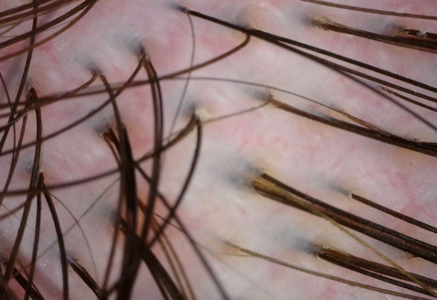


Male androgenetic alopecia Treatment

IN LONDON

DE FELIPE group is an international network of clinics and not all treatments are available at every location. We kindly invite you to contact us to confirm whether the treatment you require is offered at your chosen clinic.

What is ?

Male pattern androgenetic alopecia (MAGA) consists of hair loss on the crown, the forehead, and the entire upper part of the scalp. Men who suffer from androgenetic alopecia eventually go bald over time, with some experiencing more and others less depending on their genetics.

Since most men and many women develop androgenetic alopecia, it should be considered a normal part of aging, rather than a disease.

It is known that approximately 8 out of 10 men in the United Kingdom will develop male pattern androgenetic alopecia.

Causes

Androgenetic alopecia can be described as a process in which the hair roots become dormant.
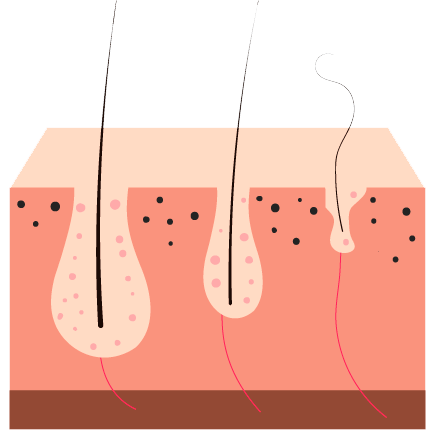
Miniaturization

Androgenetic alopecia is due to a problem in the re-entry of follicular stem cells into the anagen phase, or hair growth. This halt in re-entry is caused by the action of dihydrotestosterone on androgen receptors.

As a result, the hair becomes increasingly finer and smaller, which causes sufferers to interpret their hair as falling out more rapidly. However, the hair does not fall out in greater quantities or at a faster rate: its caliber decreases, and this phenomenon is known as miniaturization.

Since the hair on the top of the head has the most receptors for this hormone, these are the areas where baldness occurs.

Dihydrotestosterone (DHT) receptors

The degree of development of Androgenetic Alopecia depends more on the number of Dihydrotestosterone (DHT) receptors than on the level of this hormone.

These receptors are expressed primarily in the upper regions of the scalp, as we mentioned above, and are key to understanding why and where we go bald. The posterior region of the scalp and the lateral areas do not have DHT receptors and are used to supply follicles in hair transplants.

There is a wide variety of DHT receptor distribution patterns in the scalp, which explains why some men go bald very early, others primarily in the receding hairline, and some very diffusely.

As a general rule, Caucasian men have more receptors than Asians and therefore develop an equivalent degree of Androgenetic Alopecia 20 years earlier.

Clinical Signs

Hair density decreases at the receding hairline, forehead, and crown of the head when the patient is between 20 and 30 years old. Hair density on the upper scalp then decreases toward the age of 40, leading to complete baldness between the ages of 40 and 60.

The trichoscopic signs of Androgenetic Alopecia are as follows:
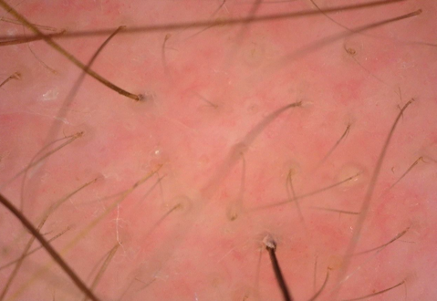
  • Anisotrichosis: Uneven hair growth in the same areas of the scalp.
  • Localized or cranial involvement: Presence in the frontotemporal, parietal, and vertex regions

  • Presence of a peripilar halo: hairs surrounded by a circle that demarcates the size of the largest former follicle.

  • Monotrichosis in affected areas. Absence of multiple hair shafts in each follicle.

  • Empty ostia (yellow dots).

Trichoscopy of a 35-year-old man with AGA. On the left, an image of the frontal region (entrances) and on the right, the occipital or posterior region.

Diagnosis

The diagnosis of male pattern baldness is made clinically and with trichoscopic findings. Androgenetic alopecia is caused by genetic factors that predispose naturally produced hormones to miniaturize hair.

Androgenetic alopecia is not a hormonal disorder, nor does it cause pathologically increased or decreased hormone production, so blood tests are not required.

DE FELIPE group is an international network of clinics and not all treatments are available at every location. We kindly invite you to contact us to confirm whether the treatment you require is offered at your chosen clinic.

Male androgenetic alopecia treatment price London

The price of the different procedures for the treatment  is:

Single session fee

Treatments

Platelet-Rich Plasma (PRP)

£250

Minoxidil Microinjections

£100

5AR Inhibitor Microinjections

£100

Hair Cycle Extenders Microinjections

£100

Anti-Inflammatory Microinjections

£100

Antiandrogen Microinjections

£100

Low-Level Laser

£50

Stem Cells or Nanofat

£1500

Neuromodulators

£450

Monofilament Threads

£450

Exosomes

£450

De Felipe Male Androgenetic Alopecia (MAA) Program

£1200

Includes:

  • Diagnostic Trichology Consultation
  • 6 Platelet-Rich Plasma (PRP) Sessions
  • 6 Dutasteride Microinjections
  • 6 Finasteride microinjection
  • 6 sessions of minoxidil microinjection
  • 6 sessions of 635 nm photobiological therapy
  • Follow-up dermatological consultation

Frequently asked questions

The most frequently asked questions about male androgenetic alopecia can be found here:

There are different treatments for male pattern baldness. Depending on the route of administration, treatments can be oral, topical, or microinjected. Depending on the treatment objective, they can be divided into two broad groups: treatments that slow the progression of androgenetic alopecia (5-alpha reductase inhibitors) and treatments that stimulate hair growth.


To understand the causes of male pattern baldness, you can visit the «Causes» section of this page. Briefly, androgenetic alopecia consists of hair miniaturization caused by the action of a hormone called Dihydrotestosterone (DHT) on androgen receptors.

There is no treatment that «eliminates» male pattern baldness. Male pattern baldness is a chronic hair condition, and no treatment can permanently erase it. The biological mechanisms that occur in male pattern baldness are currently understood, and treatments can be developed to slow its progression, slow the hair’s miniaturization process, and stimulate hair growth. These treatments can make male pattern baldness virtually imperceptible.

To confirm whether you have male pattern baldness, a dermatological diagnosis is necessary.

If you haven’t seen or can’t see a dermatologist, you may suspect to have male pattern baldness if you notice that the hair on the top of your head has progressively become smaller over time and most frequently in the hairline and crown region.