

Frontal Fibrosing Alopecia (FFA)

IN LONDON

DE FELIPE group is an international network of clinics and not all treatments are available at every location. We kindly invite you to contact us to confirm whether the treatment you require is offered at your chosen clinic.

What is it?

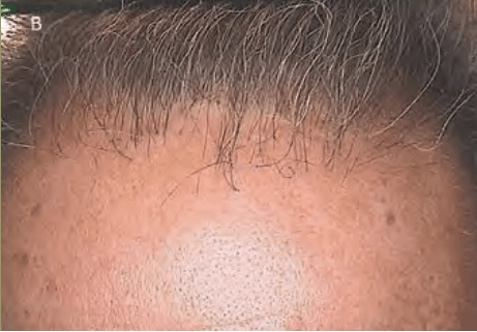
Frontal fibrosing alopecia (FFA) is a type of scarring alopecia that causes a progressive receding of the frontal hairline with the loss of fine hair. This reveals an area of scalp without sun spots and with a whiter texture. It is accompanied by an itchy sensation in the forehead and sideburns.

This type of alopecia is becoming increasingly common, and its exact causes are still unknown. It is more common in women after menopause, but it can also occur in women before menopause and in men.

Causes

There has been speculation about the causes of Frontal Fibrosing Alopecia. It is believed to have a dual autoimmune and hormonal mechanism.

The autoimmune mechanism involves the body attacking the hair and causing inflammation. If the inflammation is not stopped in time, it can lead to the permanent destruction of the hair follicle. Regarding the hormonal mechanism, it is known that people with Frontal Fibrosing Alopecia have a decrease in the sex hormone dehydroepiandrosterone (DHEA), which, interestingly, is lower after menopause or at older ages, precisely when Frontal Fibrosing Alopecia most commonly occurs.

It is also noteworthy that treatment with 5-Alpha reductase inhibitors (the same ones used for Androgenetic Alopecia) such as Finasteride and Dutasteride are among the most effective in halting this process.

Clinical Signs

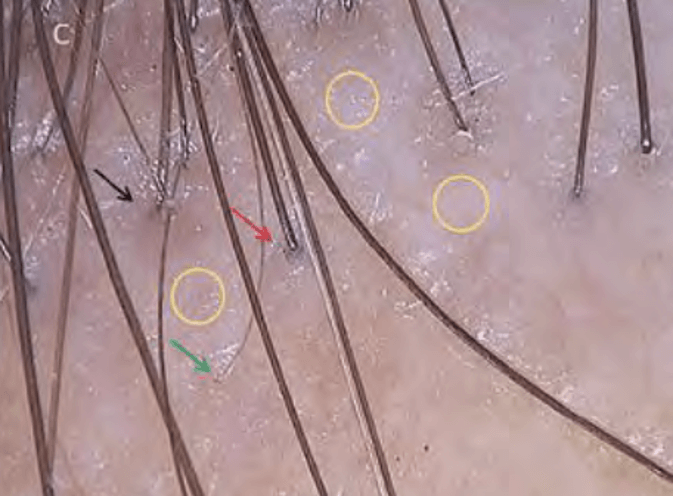
There are different clinical signs that allow us to diagnose Frontal Fibrosing Alopecia (FFA) compared to other types of alopecia, and understanding them will be the key to proposing an appropriate treatment plan:
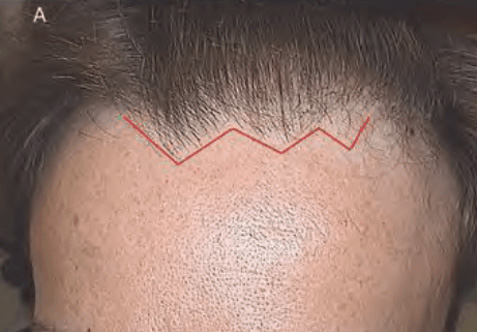
  • Redness around the hair root or perifollicular erythema.

  • Follicular hyperkeratosis.

  • Frontotemporal hairline recession.

  • Solitary hair sign.

  • Itching and pain. Trichodynia.

  • Hair loss in the eyebrow. This is a very frequently associated sign. It can also affect the armpits, pubis, forearms, or eyelashes.

  • It primarily affects postmenopausal women.

  • Hair loss.

  • Loss of follicular openings.

  • Peripilular casts.

  • Perifollicular erythema.

Diagnosis

To establish a diagnosis of Frontal Fibrosing Alopecia, the following are required:

  1. Appearance of characteristic clinical signs (patient is usually female, location in the frontal region, solitary hair sign, receding frontal hairline, etc.)
  2. Characteristic findings on trichoscopy.
  3. A biopsy is rarely required. The diagnosis is generally clinical, that is, a combination of data obtained from the patient and what is observed by the Specialist.

DE FELIPE group is an international network of clinics and not all treatments are available at every location. We kindly invite you to contact us to confirm whether the treatment you require is offered at your chosen clinic.

Frontal Fibrosing Alopecia treatment price London

The price of the different procedures for the treatment  is:

Single session fee

Treatments

Platelet-Rich Plasma (PRP)

£250

Microinjections with minoxidil

£100

Microinjections with 5AR inhibitors

£100

Microinjections with hair growth enhancers

£100

Microinjections with anti-inflammatories

£100

Microinjections with antiandrogens

£100

Low-Level Laser

£50

Stem Cells or Nanofat

£1500

Neuromodulators

£450

Monofilament Threads

£450

Exosomes

£450

De Felipe Program: Fibrosing Frontal Alopecia (FFA)

£1200

Includes:

  • Diagnostic Trichology Consultation
  • 6 Platelet-Rich Plasma (PRP) sessions
  • 6 microinjection sessions with Co-trichosteroids
  • 6 sessions of microinjections with Dutasteride
  • 6 sessions of microinjections with Finasteride
  • 6 sessions of microinjections with Minoxidil
  • 6 sessions of 635 nm photobiological therapy
  • Frequently Asked Questions

Frequently asked questions

The most frequently asked questions about fibrosing frontal alopecia can be found here:

There is currently no cure for frontal fibrosing alopecia, but there are treatments that can treat its symptoms and slow its progression. In any case, early diagnosis is crucial for achieving optimal results.
Whether hair can grow back in areas affected by frontal fibrosing alopecia will largely depend on the degree of progression of the condition and the timing of treatment. For hair to regrow in areas affected by frontal fibrosing alopecia, it is essential to halt its progression before the hair follicles are destroyed. After the follicle is destroyed, hair will no longer grow back.
The exact cause of frontal fibrosing alopecia is still unknown, but it is believed to be due to a combination of autoimmune, genetic, and hormonal factors. Recent studies have shown that approximately 10% of patients with frontal fibrosing alopecia have a family member who also suffers from it.
In-clinic treatment for frontal fibrosing alopecia can be uncomfortable, but it is easily tolerated by most patients. Despite the fact that it involves needles to inject medication or other substances, at De Felipe Clinic we try to minimize pain by using very fine needles and anesthetic systems to make our patients’ experience as painless as possible.