


DE FELIPE group is an international network of clinics and not all treatments are available at every location. We kindly invite you to contact us to confirm whether the treatment you require is offered at your chosen clinic.
What is ?
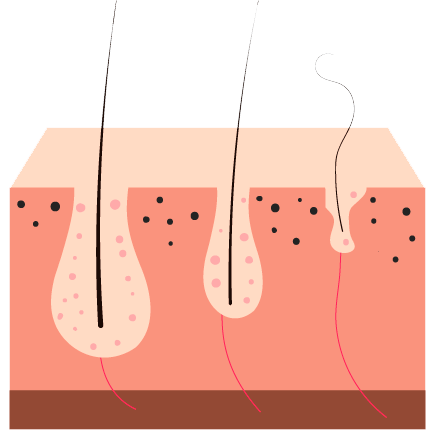
Female pattern androgenetic alopecia (FAGA) is a condition in which the hair on the top of the scalp becomes miniaturized or thinner throughout life, evenly distributed across the parietal or upper part of the scalp. This causes a loss of hair density that suggests hair loss, although in reality the change affects the thickness rather than the total number of hairs.
Female pattern androgenetic alopecia is not a disease or disorder but rather a genetic variation that causes people to go bald. This variety primarily affects women and develops throughout life. Some men also develop diffuse pattern baldness on the top of the scalp and are said to have FEMALE PATTERN ANDROGENETIC ALOPECIA.
4 out of 10 women worldwide will develop androgenetic alopecia. It is due to a problem in the re-entry of Follicular Stem Cells into the anagenic or growth phase
.
Causes
Androgenetic alopecia can be described as a process in which the hair roots become dormant.
Clinical Signs
Hair density decreases at the receding hairline, forehead, and crown of the head when the patient is between 20 and 30 years old. Hair density on the upper scalp then decreases toward the age of 40, leading to complete baldness between the ages of 40 and 60.
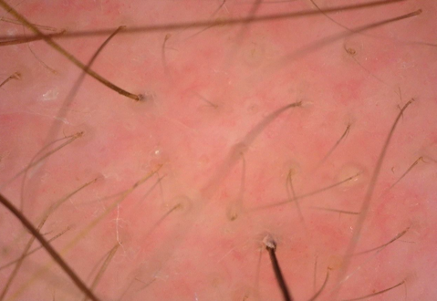
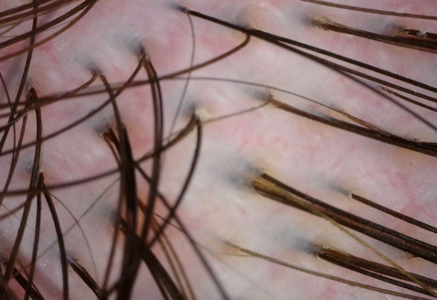
The trichoscopic signs of Androgenetic Alopecia are as follows:
Diagnosis
The diagnosis of Female Androgenetic Alopecia is clinical and should be established when the characteristic clinical signs are observed. Trichoscopic findings are very helpful in differentiating it from other female alopecia problems such as Telogen Effluvium or Traction Alopecia.
In some cases, but not all, it is advisable to perform a complementary blood test to measure the levels of both female sex hormones (FSH, LH, prolactin, ethinyl estradiol, estrone) and male sex hormones (4-delta androstenedione, 4-SO4 DHEA, free testosterone, total testosterone, dihydrotestosterone), and other non-sex hormones (17-OH cortisol, cortisol, 11B hydroxylase, 17B hydroxylase). This is because, in some cases, some types of Androgenetic Alopecia progress more rapidly due to this excess of hormones
.
Treatments with the most scientific evidence
There are three lines of treatment for female androgenetic alopecia:
5-Alpha Reductase Inhibition
The first line of treatment consists of inhibiting 5-alpha reductase.
This stops the reduction of testosterone into dihydrotestosterone.
These treatments are contraindicated during pregnancy.
The most common are:
Androgen Receptor Blockers
The second line of treatment is antiandrogens or androgen receptor blockers.
These treatments cannot be used for androgenetic alopecia in men or in pregnant women. They include:
Hair Growth Stimulation
The third line of treatments is the stimulation of hair growth, this involves administering substances or molecules that awaken the follicular stem cells from their dormancy (telogen phase).
The treatments most commonly proposed by dermatologists in scientific publications are:
DE FELIPE group is an international network of clinics and not all treatments are available at every location. We kindly invite you to contact us to confirm whether the treatment you require is offered at your chosen clinic.
Female Androgenetic Alopecia treatment price London
The price of the different procedures for the treatment is:
Frequently asked questions
The most frequently asked questions about female androgenetic alopecia can be found here: