



DE FELIPE group is an international network of clinics and not all treatments are available at every location. At our London clinic, some treatments subject to CQC registration are not yet available, but will be offered soon. We kindly invite you to contact us to confirm whether the treatment you require is offered at your chosen clinic.
Dermatology clinic specialising in the treatment of acne scarring and its after-effects
Acne doesn’t always end when the breakouts clear. For many patients, it leaves a lasting mark on the skin — scars that change its texture, or patches of discolouration that take months to fade on their own. Both are genuinely common, and both can be treated.
At our dermatology clinic in London, we specialise in diagnosing and treating the visible after-effects of acne, from early redness and pigmentation through to established, long-standing scarring. Dr Íñigo De Felipe’s team starts every case with a close assessment of the skin — depth, distribution and the type of scarring involved — because that’s what determines which treatment, or combination of treatments, will actually work. There’s no single approach that suits everyone: the right plan depends on skin type, scar depth and how the skin has responded to previous treatment, if any.
What are acne scars and acne marks?
These two terms get used interchangeably, but clinically they’re quite different, and that difference matters for treatment.
Types of acne scars
What’s the best treatment for acne scars?
There’s no single ‘best’ treatment — the right combination depends on the type of scarring, its depth and how your skin responds. In most cases, the most effective results come from combining two or more techniques over a course of sessions, rather than relying on just one. The main options we use at our London clinic are:
FRACTIONAL CO2 LASER
Delivers controlled heat to the skin in a fine grid of microscopic points, triggering the skin to rebuild collagen in the treated areas. It’s one of the most effective options for boxcar and rolling scars, and is usually given as a short course of sessions spaced roughly a month apart.
SUBCISION
A fine needle is used to release the fibrous bands tethering a rolling or boxcar scar to the tissue beneath it, letting the skin lift back up to a more even level. Often combined with filler or PRP in the same session for a more complete result.
Poly-L-lactic acid (PLLA) / biostimulators
A collagen-stimulating injectable that works gradually, encouraging the skin to rebuild its own structure over several weeks. Particularly useful for more generalised volume loss across a larger scarred area.
Medium and deep chemical peels
Controlled exfoliation that removes damaged superficial layers of skin, encouraging smoother, more even regrowth. Best suited to more superficial scarring and textural irregularities rather than deep, tethered scars.
Hyaluronic acid filler
Used to lift shallow, soft-based scars from underneath, giving an immediate improvement in surface texture. Results are temporary and typically need topping up every several months.
Platelet-rich plasma (PRP)
Plasma taken from the patient’s own blood, rich in growth factors that support tissue repair. Frequently combined with subcision, microneedling or laser treatment to support the skin’s own healing response.

CO2 laser for treating acne scars
The fractional CO2 laser is one of the most consistently effective tools we have for acne scarring, and it deserves a closer look. It works by delivering intense, controlled heat to thousands of microscopic points across the treated area, while leaving the surrounding skin untouched. This controlled thermal injury triggers a genuine repair response: fibroblasts — the cells responsible for producing collagen — are activated, and over the following weeks the skin gradually rebuilds a firmer, more even structure from within. Because only a fraction of the skin’s surface is treated at any one time, recovery is faster than with older, fully ablative lasers, while still delivering a meaningful improvement in scar depth and texture.
Can acne scars be treated on darker skin tones?
Yes, but the approach needs to be adjusted. Darker skin is more prone to post-inflammatory hyperpigmentation — dark patches that can appear after any treatment that provokes inflammation in the skin, including some lasers. For this reason, we generally favour non-ablative fractional lasers, Morpheus8, subcision, dermal fillers and PRP for patients with darker skin tones, as these carry a meaningfully lower risk of triggering pigmentation changes than more aggressive ablative treatments. A proper skin assessment before treatment is essential to choose the safest, most effective combination.
Is it possible to get rid of acne scars completely?
Most patients see a genuine, visible improvement of 60% or more with the right combination of treatments, but it’s important to be honest about what’s realistic: the goal of treatment is to reorganise and rebuild the skin’s own collagen, not to erase the scar entirely. For the vast majority of patients, that’s enough to make a real difference to how the skin looks and feels — but we’d rather set that expectation clearly from the first consultation than overpromise.
Advice to help prevent acne scarring
- 1See a dermatologist early. The sooner active acne is properly controlled, the less chance it has to cause lasting damage to the skin.
- 2Don’t pick, squeeze or manipulate spots. This is one of the single biggest risk factors for scarring — it increases inflammation and damage to the deeper layers of skin.
- 3Introduce retinol into your skincare routine, under guidance, as it supports healthier skin turnover and can help reduce the risk of marks forming.
- 4
Wear daily sun protection. UV exposure makes any post-acne mark darker and slower to fade.
- 5
Avoid smoking, which impairs the skin’s ability to heal and repair itself.
Scientific evidence
Our treatment protocols are informed by published clinical research, including studies covering:
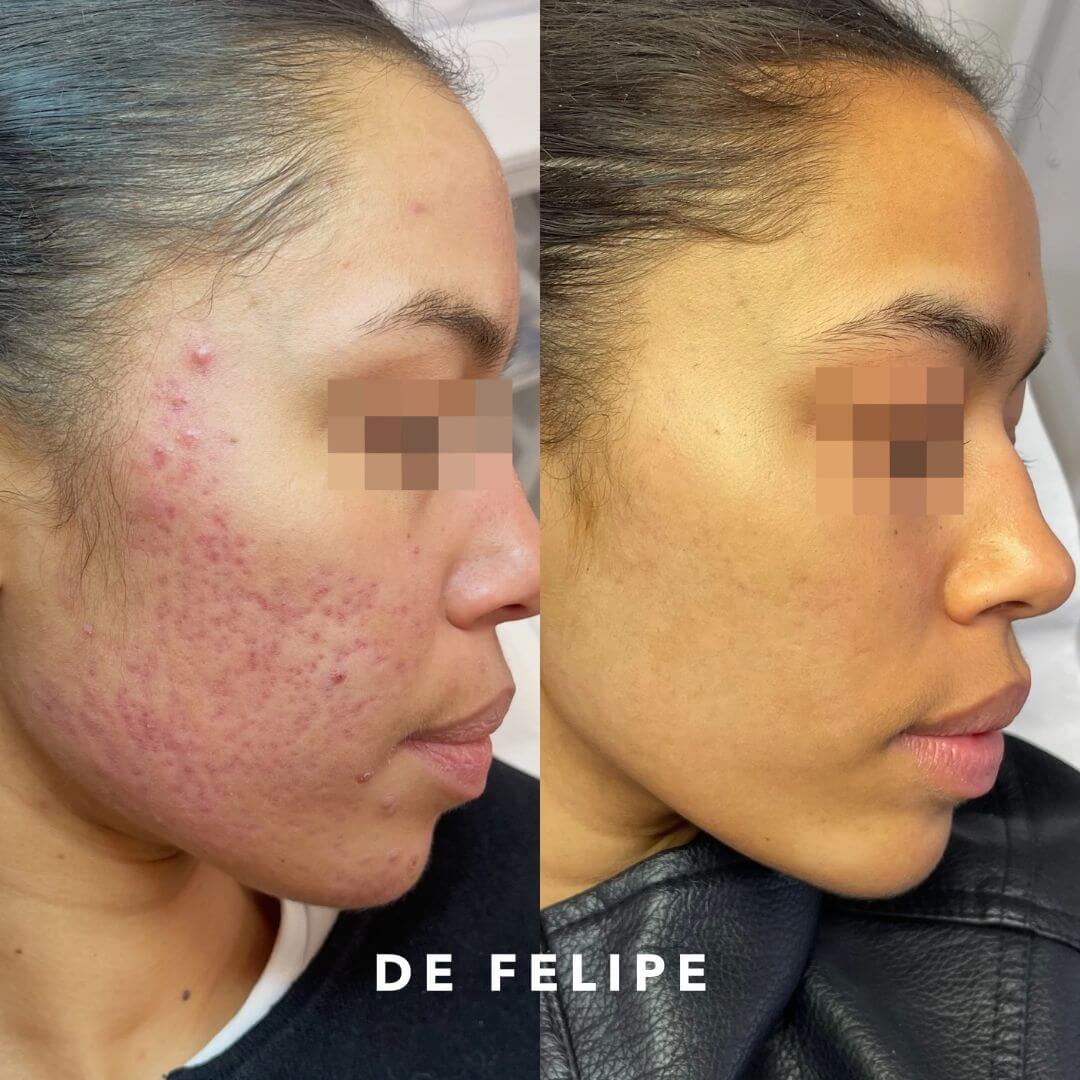
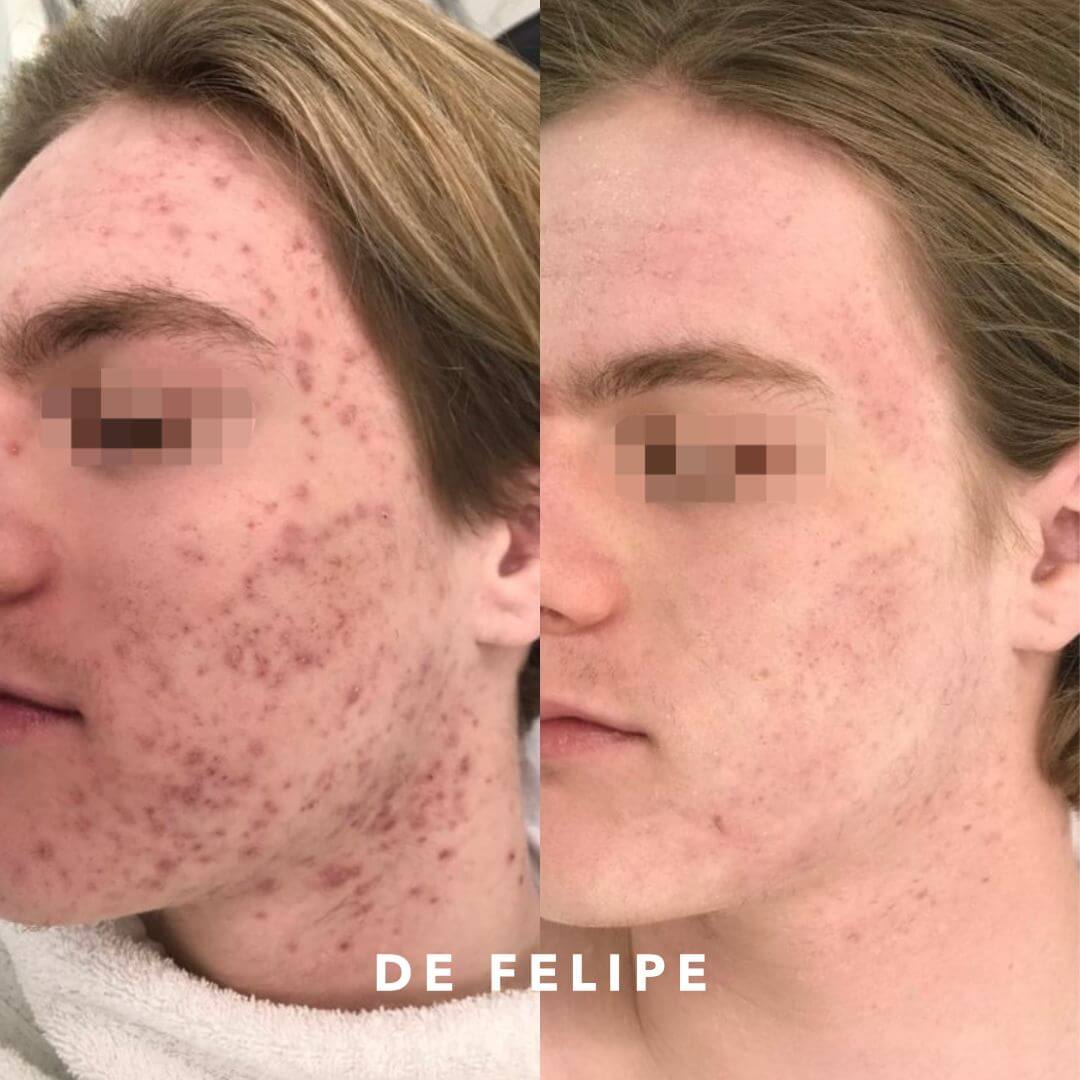
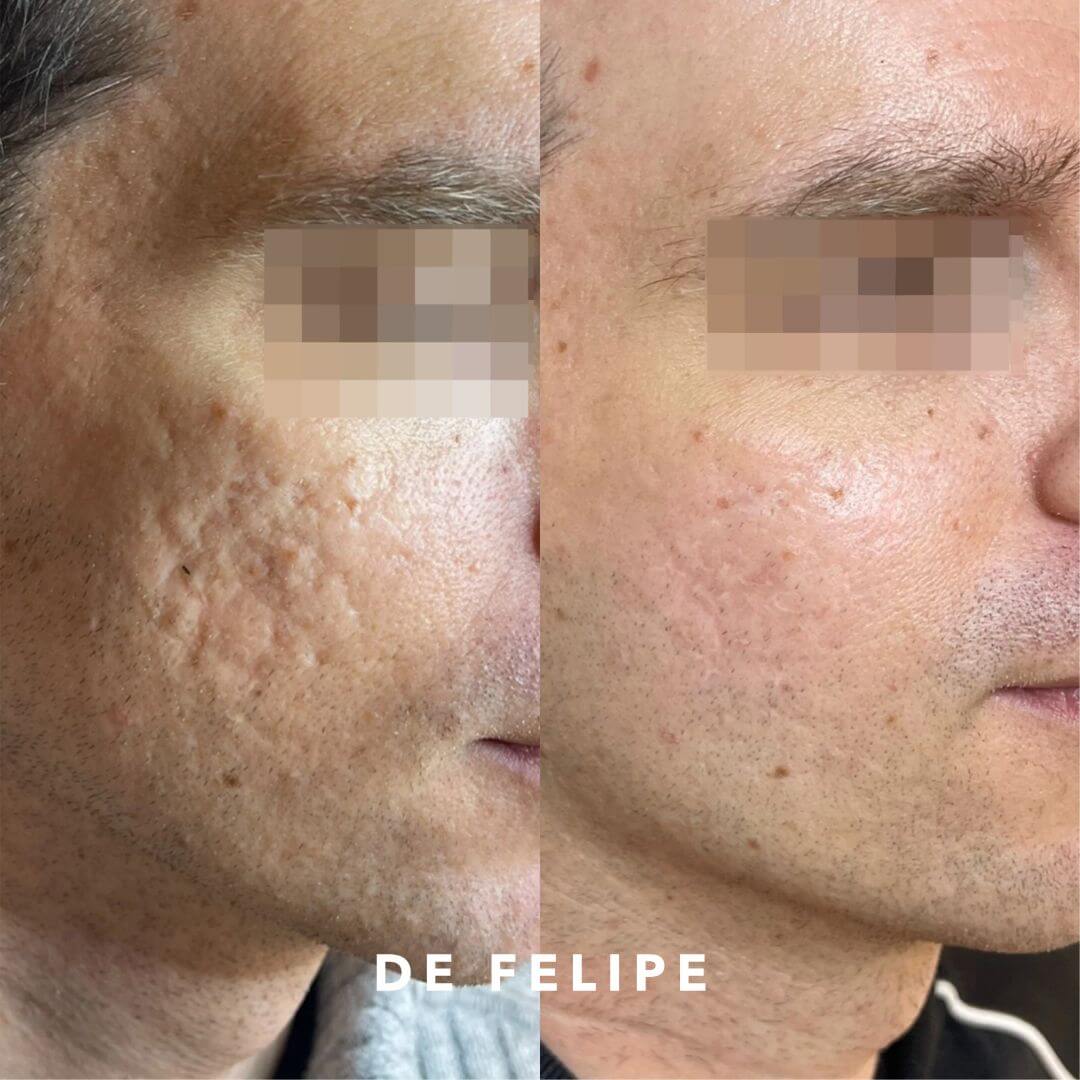
Acne scar removal: before and after
At De Felipe Dermatology Clinic, we treat acne scars with a comprehensive approach that targets the different underlying causes of scarring to achieve the best possible results. Our personalised programmes deliver a marked, well-rounded improvement that lasts, while always preserving the natural look of the face.
Acne scar treatment cost in London
The right treatment plan — and therefore the cost — depends on the type and depth of scarring and the number of sessions needed. Below are our current individual session fees and our CO2 laser package.
Frequently asked questions from our patients