


DE FELIPE group is an international network of clinics and not all treatments are available at every location. We kindly invite you to contact us to confirm whether the treatment you require is offered at your chosen clinic.
What is it?
Lichen planus pilaris (LPP) is a type of scarring alopecia, where the inflammation that develops around the hair destroys it, causing it to disappear permanently.
It occurs in certain areas of the upper scalp, such as the parietal region. It occurs primarily in middle-aged women and is frequently associated with other autoimmune disorders.
Clinical Signs
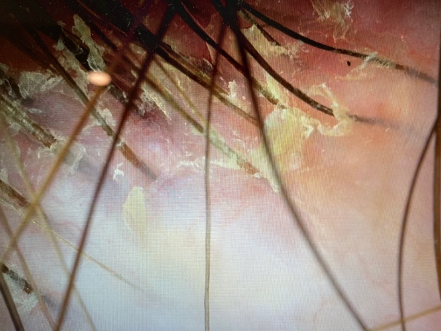
There are different clinical signs that allow us to diagnose Lichen Planus Pilaris (LPP) compared to other types of alopecia, and understanding them will be key to proposing an accurate treatment plan:
Diagnosis
The diagnosis is established using the following criteria:
- The appearance of characteristic clinical signs such as itching, redness, bald areas resembling «snow footprints» or «footprints in grass,» and the location of the lesions in the parietal region of the scalp.
- Characteristic trichoscopic signs include disappearance of follicular openings, perifollicular erythema, perifollicular casts, and telangiectasias.
- In some cases, there may be some overlap with frontal fibrosing alopecia, so a skin biopsy may be performed to rule out one or the other. These biopsies reveal the fibrosis and scar tissue typical of LPP.
- A series of major criteria (2018) have been proposed for the diagnosis of LPP or FFA, including: scarring alopecia in the characteristic areas and diffuse bilateral alopecia in the eyebrows, and minor criteria such as:
a) characteristic trichoscopy with peripapillary erythema, peripillary scaling, or both
b) histology with fibrosis
c) involvement of other areas such as hair loss on the body, face, etc.
The diagnosis could be established with two major criteria, or one major and one minor. - There are no blood findings that help confirm the diagnosis of Lichen Planus Pilaris, but there is an association with other autoimmune diseases such as hypothyroidism, rosacea, or fibrosing frontal alopecia.
There is no consensus regarding whether screening for all of these diseases should be performed in these patients.
Treatments with the most scientific evidence
First-line treatments
Second-line treatments
DE FELIPE group is an international network of clinics and not all treatments are available at every location. We kindly invite you to contact us to confirm whether the treatment you require is offered at your chosen clinic.
Lichen Planus Pilaris treatment price London
The price of the different procedures for the treatment is:
Frequently asked questions
The most frequently asked questions about lichen planus pilaris can be found here: