


Jawline rejuvenation is becoming part of routine aesthetic practice. Many of our patients after having treated the middle third of the face (furrows, cheekbones or the base of the eyebrows) are interested in treating the lower third: lips, chin and jawline.
This time we will talk about the non-surgical treatment of the chin and jaw, as these anatomical structures play a fundamental role in facial harmonisation and the perception of beauty. They define the contour and balance of the face.
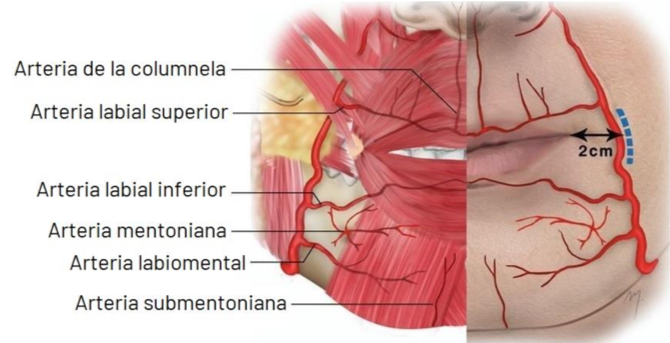
Photo 1. Arteries of the mouth and chin.
A well-contoured jawline is an affable feature in both men and women. A straight, well-defined jawline expresses youthfulness and enhances the attractiveness of the lower third of the face. In contrast, a sagging jaw is an indicator of facial ageing and can have a negative impact on a patient’s appearance.
The lowering of the cheek combined with progressive bone resorption due to age leads to the development of two aesthetic problems: disruption of the jawline and the appearance of jowls. An underdeveloped chin is also associated with a less aesthetically pleasing facial profile and may contribute to early loss of jawline definition.
For women, the most aesthetically appealing angle is between 120 and 130 degrees; for men, the ideal angle is 130 degrees, less than 120 would create an overly square face and more than 130 would create a more oval jawline.
However, beauty cannot be defined by a mathematical formula: it is a reflection of the structure, position and volume of bone and subcutaneous tissue, the quality of the skin and the personality of each individual. Harmonious proportions of the facial thirds and other features such as the eyes, nose, lips, chin and neck are essential for an attractive face.

Photo 2. Aesthetic units of the mandible
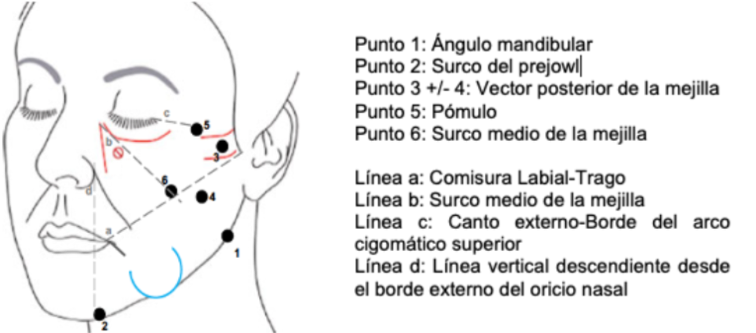
Photo 3. Dellara injection sites
Treating lack of elasticity
To improve the quality of the skin and treat sagging and laxity in this area, collagen biostimulators are the star: polylactic acid and calcium hydroxyapatite. Depending on each age, we will do a certain number of sessions so that there is an effective production of a collagen and elastin network that «pulls» and creates the desired lifting effect. In some patients we recommend preceding a HIFU or carboxytherapy treatment, especially if there has been previous surgery or accelerated weight loss. Once more skin density and elasticity is obtained, we recommend the use of tensor threads to optimise the treatment.
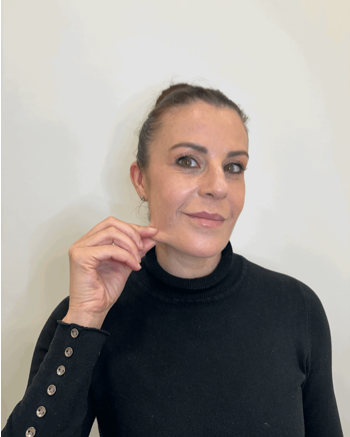
Photo 4. Woman with flaccidity
Support the entire face and neck and enhance features.
Hyaluronic acid is our main ally to achieve a very clear and marked definition of the features, especially the masculine ones. Although it can be used for all patients and many women shape their chin and face with this product with excellent results, in recent years, jaw and chin marking in men has become the new «six-pack» in this society with so many beauty canons.
The ageing process varies from person to person, so the first step in advising a patient is to assess both the patient’s physical appearance and expectations.
It is common for patients to seek rhinoplasty thinking that their nose is large, when what they really have is a small chin, and it is this defect that makes their nose appear large, which is actually proportionally normal to the rest of the face. Similarly, many patients who come for midface augmentation secondary to zygomatic/malar bone loss do not realise that age-related bone resorption occurs throughout the face, including the mandible and chin, and that to maintain the aesthetic proportions of the face, the lower third of the face must also be harmonised.
We can conclude that, compared to dermal fillers, surgical treatment has a higher risk of major complications and produces a permanent alteration of the chin, which may not look natural or may no longer be appropriate with ageing and the mandibular bone resorption that will occur in the following years.
In contrast, dermal fillers such as hyaluronic acid and collagen biostimulators offer a more natural effect and are a temporary alternative that does not require incisions, allowing correction of anterior, vertical and transverse deficits of the chin, as well as treatment of adjacent structures such as lips, marionette lines and jawline.
Bibliographical references
- B M, CH W. Changes in the facial skeleton with aging: implications and clinical applications in facial rejuvenation. Aesthetic plastic surgery [Internet]. 2012 Aug [cited 2021 Jul 20];36(4):753–60. Available from: https://pubmed.ncbi.nlm.nih.gov/22580543/
- FB N, AN D, F M, MT C. Assessing the influence of chin prominence on perceived attractiveness in the orthognathic patient, clinician and layperson. International journal of oral and maxillofacial surgery [Internet]. 2012 Jul [cited 2021 Jul 20];41(7):839–46. Available from: https://pubmed.ncbi.nlm.nih.gov/22340990/
- Vazirnia A, Braz A, Fabi SG. Nonsurgical jawline rejuvenation using injectable fillers. Journal of Cosmetic Dermatology. 2020 Aug 1;19(8):1940–7.